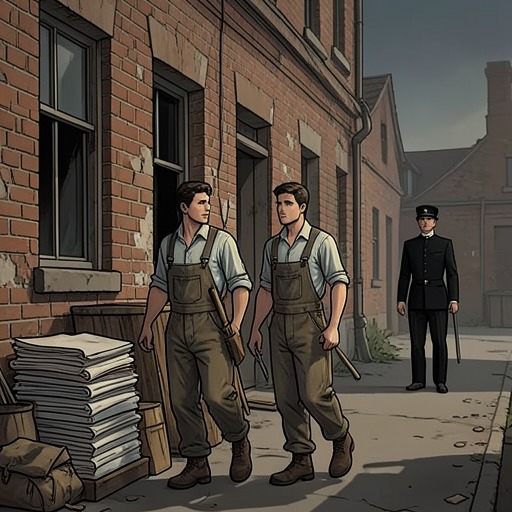
The Boys Move Band Equipment and Refuse the Instruments
Motherless BrooklynThe Boys Move Band Equipment and Refuse the Instruments is an early demonstration of how Frank Minna’s work joins practical errands to strict rules about loyalty and discretion. What begins as a cold, unexplained loading job ends with the boys turning down equipment worth thousands of dollars, Frank accepting a cash gesture on their behalf, and Lionel learning that the men they have just met are to be known only as clients. The episode makes the transfer itself—and the refusal to profit from it—the means by which Minna teaches the shape of his business.
An unexplained assignment
One fall day, four or five months after meeting Frank Minna, Lionel Essrog, Tony Vermonte, Danny Fantl, and Gilbert Coney were gathered in Minna’s old van without being told what the assignment was. Minna seemed unusually agitated, and Lionel’s own ticcing intensified as he copied the nervous jerks of Minna’s head while he drove. They crossed the Brooklyn Bridge into Manhattan, then doubled back beneath it to the docks near Fulton Street. Minna went into a small, windowless shack made of corrugated steel, leaving the boys outside in the wind off the East River.
The wait establishes the job’s uneasy, hurried tone before its purpose is clear. Lionel danced around the van and counted the bridge’s suspension cables. Tony and Danny, inadequately dressed in thin plaid jackets, kicked and cursed at him; Gilbert, warmly padded in a fake-down coat, methodically tossed corroded chunks of concrete into the river. Their different ways of enduring the cold give the scene its ordinary, comic surface, while Minna’s jumpiness signals that this is not a routine delivery.
The transfer
Minna emerged as two small yellow Ryder Rental trucks arrived. Both were running, and their drivers sat smoking in the cabs. One truck was pristine, the other dingy; neither was padlocked. Minna opened the backs and directed the boys to move the contents into his van quickly. The first object Lionel handled was a flying-V electric guitar painted with yellow and silver flames, its cable dangling from the socket. Other guitars and basses sat in hard black cases, but that instrument had been unplugged and shoved into the truck in haste.
The cargo was extensive: seven or eight guitars, keyboards, electronic control panels, bundles of cable, microphones and stands, floor effects pedals, a drum kit loaded whole rather than disassembled, and numerous amplifiers and monitors. Six black stage amplifiers, each about half the size of a refrigerator, filled the second truck and required two boys apiece to lift. The cases bore a band name Lionel only faintly recognized; he learned later that the group had had a minor AM hit or two. The load was enough for a small stadium show, a scale that made the boys’ hurried work more than the handling of a few stray instruments.
At Matricardi and Rockaforte’s brownstone, the exterior gave way to a radically altered interior. Narrow halls, stairs, spoked banisters, and ornate ceilings remained, but much of the building had been gutted into a warehouse-like stairwell serving the basement and upper floors. A clean white wall and one closed door sealed off the parlor floor to the left. The boys carried the equipment upstairs while Minna stayed behind to guard the van; the drums were easy to move, and the band’s gear fitted into one corner of the apartment on wooden pallets apparently placed for it.
A house divided, a gift refused
The upper floors were otherwise nearly empty, with a few crates and an oak dining table piled with hundreds of heavy silver forks, spoons, and butter knives. Their handles all faced the same direction. Lionel lingered over the forks, whose sculpted forms stood in sharp contrast to the crude cutout steel utensils he remembered from the boys’ institutional kitchen. The warehouse space and the carefully aligned silverware make the house’s upper rooms feel ordered for purposes the boys do not understand.
The closed door concealed a striking reversal. Behind the stripped-down building’s clean partition, the old parlor architecture remained intact: gold leaf on plaster scrollwork, antique furniture, a marble-topped side table, a mirror-lined grandfather clock, fresh flowers, and an old, richly colored carpet. Framed photographs, none more recent than the invention of color film, made the room resemble a museum display of an older Brooklyn. Two elderly men in matching brown suits sat there: Matricardi and Rockaforte. Their opulent, preserved parlor contrasted with the bare, functional spaces through which the boys had just carried the equipment.
After the boys met the clients, Rockaforte asked whether they recognized the belongings they had moved. Minna immediately intervened when the equipment was offered to them as a gift. The refusal was not casual: Lionel understood that Minna considered it imperative, and that the instruments, worth thousands or perhaps tens of thousands of dollars, could not be accepted. His mind nevertheless began to turn the gear into the imagined instruments of a band, inventing comic names from Minna’s insults. The fantasy registers both the appeal of the gift and the difficulty of putting it out of mind.
Rockaforte answered that nobody else would be allowed to enjoy the equipment: it could be given to the orphans or burned with gasoline, and either outcome would be the same to him. Lionel understood that the offer carried no attachment for Rockaforte and would not be forced on Minna. He also understood that the comparison to gasoline described a real possibility for the instruments. Minna heard the threat in it too and exhaled deeply; the immediate danger had passed, though Lionel’s attention remained caught by the rejected gear.
Payment and the rule of silence
Matricardi then offered another form of gratitude. He took four hundred-dollar bills from the inside pocket of his suit jacket, passed them to Frank, and nodded toward the boys. Minna, now able to joke as the encounter came to an end, observed that the money would spoil them and told them to thank the clients. Lionel saw Matricardi’s generous gesture as the source of Frank’s later habit of spreading twenty-dollar bills around; beside four hundreds, Frank’s smaller payments seemed to him almost childish and cheap. The scene distinguishes the refused equipment from the money that Matricardi actually handed to Frank: the boys did not leave with the instruments, and the account does not describe the cash being distributed to them.
Afterward, Frank explained the part of the job that the boys still needed to learn: the names of the two men they had met were not to be repeated. When asked what they should call them, he instructed them to call them nothing. Sometimes, he said, clients were simply clients, with no names attached. The lesson turns the day’s sequence into a compact initiation: the boys can be trusted to move valuable cargo, but they must also learn to refuse what Minna refuses and to keep the identities behind an assignment out of circulation. The polished parlor, the anonymous load, the declined gift, and the four bills all lead to the same practical boundary between what the boys handle and what they are permitted to know or say.